
How Much Light Do Succulents Need?
Most succulents need 6 or more hours of bright light a day — the single most limiting factor when growing them indoors. Here’s exactly how much, the best window direction for your hemisphere, how to measure light you can’t trust your eyes to judge, and how to read the warning signs.
Light Needs at a Glance
Succulents split into three broad light groups. Match your plant to the right one before choosing a spot.
| Light group | Daily light | Typical plants |
|---|---|---|
| Full sun | 6+ hrs direct / very bright | Most Echeveria, Sedum, Agave, cacti |
| Bright indirect | 4–6 hrs bright, filtered | Haworthia, Gasteria, Aloe |
| Low light tolerant | 2–4 hrs bright | Sansevieria, some Haworthia |
When in doubt, more bright light is safer than too little — stretching from low light is far more common than sunburn indoors.
How Much Light, Really
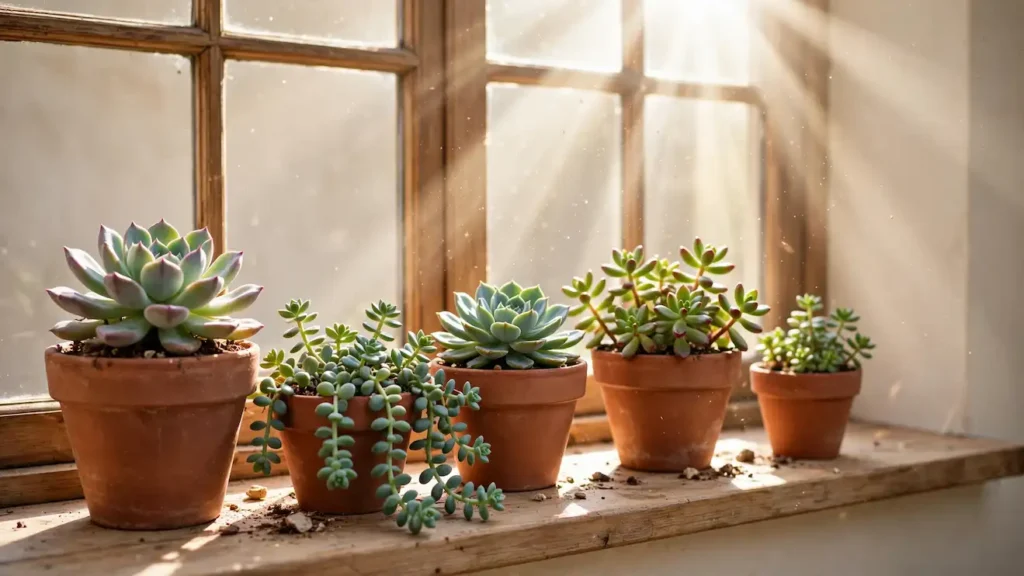
Outdoors, most succulents want full sun or part sun. Indoors, light is dramatically weaker than it looks, so aim for the brightest spot you have and 6+ hours of exposure. Some species tolerate less, but growth slows and colour fades. Rotate pots weekly so they grow evenly instead of leaning toward the window.
New or recently moved plants need easing in. A succulent taken straight from indoors to full outdoor sun will scorch — acclimate it over 1–2 weeks (see the acclimation steps below).
Best Window Direction (by Hemisphere)
Most guides assume the Northern Hemisphere. Here’s the version that works wherever you live — the sun-facing side of your home gets the strongest light.
| Exposure | N. Hemisphere | S. Hemisphere | Light level |
|---|---|---|---|
| Strongest | South-facing | North-facing | Brightest — best for full-sun types |
| Strong PM sun | West-facing | West-facing | Bright, hot afternoons — watch for burn |
| Gentle AM sun | East-facing | East-facing | Bright, cooler — great all-rounder |
| Weakest | North-facing | South-facing | Low — only for shade-tolerant types |
Keep plants close to the glass but not pressed against hot summer panes, which can scorch leaves.
How to Measure Light (Your Eyes Lie)
Human eyes adjust so well between rooms that we’re terrible at judging light intensity — a spot that looks “bright” can be a fraction of what a succulent needs. Three reliable ways to check:
| Method | How | What you want |
|---|---|---|
| Shadow test | Hold your hand a foot above the plant at midday | A sharp, crisp shadow = bright enough |
| Phone app / lux meter | Use a free light-meter app at plant level | ~2,000+ lux for bright-light succulents |
| Foot-candles | Measure at the leaf | 500+ fc for full-sun types |
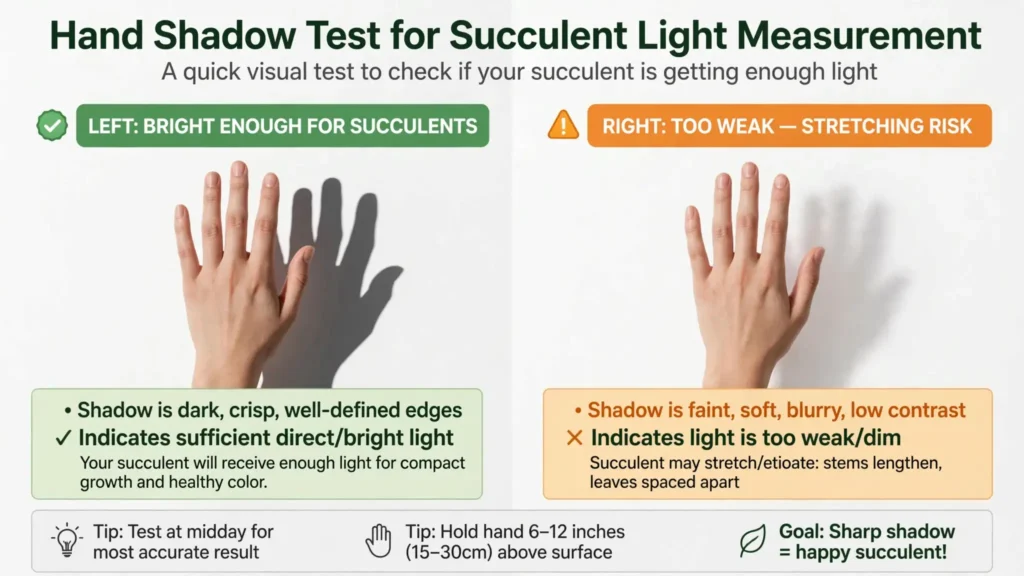
A soft, fuzzy shadow means the light is too weak and the plant will slowly stretch.
Signs of Too Little vs. Too Much Light
| Too little light | Too much light | |
|---|---|---|
| Growth | Stretched, leggy, reaching (etiolation) | Compact but stalled |
| Leaves | Pale, small, wide-spaced | Brown/white scorched patches |
| Colour | Fades to plain green | Sudden red, purple or bleached tips |
| Fix | Move brighter or add a grow light | Shade midday sun; acclimate slowly |
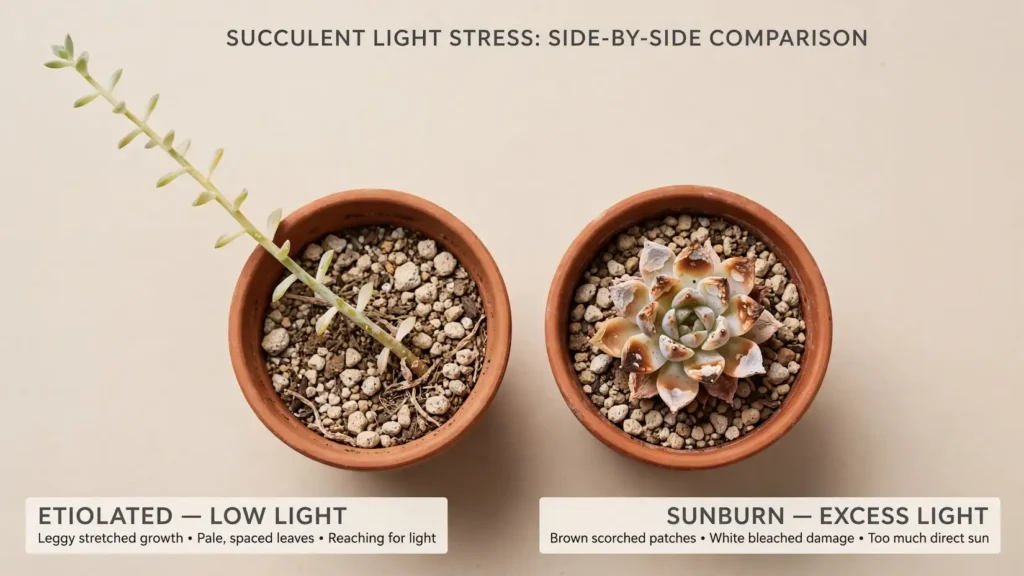
Stretching is the most common indoor problem. It doesn’t reverse — the fix is more light going forward, or beheading and re-rooting the top. Browse shade-tolerant options in our guide to low light succulents.
Using Grow Lights for Succulents
No bright window? A grow light makes a thriving collection possible in basements, offices, or dark winters. You don’t need an expensive setup — you need the right spec.
| Setting | Recommendation |
|---|---|
| Colour temperature | 5,000–6,500 K (full-spectrum, daylight white) |
| Distance from plants | 15–30 cm (6–12 in) for LED panels |
| Hours per day | 12–14 hrs on a timer |
| Type | LED panels — efficient, cool, long-lasting |
Put it on a timer and rotate plants weekly. Give them a daily dark period — plants respire at night, so 24/7 light doesn’t help.
Common Light Mistakes
- Trusting your eyes instead of checking with a shadow or lux test
- Placing plants too far from the only bright window
- Moving succulents into full sun with no acclimation (instant sunburn)
- Running grow lights 24/7 with no dark period
- Ignoring early stretching until the plant is badly leggy
Light and water work together — low light means the plant drinks less, so overwatering risk climbs. See the succulent watering guide.
Succulent Light FAQ
Most want 6 or more hours of bright light a day. Full-sun types want direct sun; shade-tolerant types manage on 2–4 hours of bright light.
Some can tolerate it, but most will stretch and fade. Choose shade-tolerant species, or supplement with a grow light.
In the Northern Hemisphere, a south- or west-facing window. In the Southern Hemisphere, a north- or west-facing one. East windows give gentle morning sun that suits most types.
Only if your natural light is weak. A full-spectrum LED at 5,000–6,500 K, 15–30 cm away, 12–14 hours a day, replaces a bright window.
It’s not getting enough light and is reaching for more (etiolation). Move it brighter or add a grow light — the stretched growth won’t shrink back.
Dial In Watering, Too
Light and water are the two levers of succulent care. Get both right and the rest is easy.
Part of the Succulent Care hub